As an Amazon Associate I earn from qualifying purchases.
If you had told me a few years ago that I’d be writing an article about recovering from systemic exhaustion without ever forcing you to set a 5:00 AM alarm, I would have laughed in your face—right before crying in my car during recess.
When you are deeply trapped in teacher burnout, standard wellness advice feels less like an invitation to heal and more like an aggressive, over-scheduled homework assignment. Being told to start a rigorous meditation practice, meal-prep 21 immaculate whole-food plant-based macro bowls, and hit a high-intensity yoga studio doesn’t inspire transformation. It makes you want to throw your laptop out a window.
The solution to teacher burnout starts with tiny, zero-willpower micro habits—like short pockets of absolute silence and effortless floor grounding—to gently down-shift a frozen nervous system without overwhelming an educator’s already depleted energy.
True burnout recovery cannot require a massive expenditure of willpower or physical energy. If your recovery strategy requires you to “push through” the fatigue, it isn’t recovery—it is just another layer of hyper-vigilance.
If you aren’t sure whether you are experiencing everyday stress or true biological exhaustion, pause and read “How is Burnout Different From Chronic Stress?” first to audit your current nervous system baseline.
Ready to Heal from Burnout?
A highly practical, science-backed guide of 5 ways to immediately trick a hyper-vigilant, stressed-out nervous system into dropping back into a deep rest state. Specifically targeting the sheer sensory overload teachers face, this guide offers 5 quick rituals to lower cortisol levels and reclaim quiet, calm energy at home.
Table of Contents
- The Burnout Paradox: When Self-Care Feels Like Homework
- Overcoming the “Savior Complex” and the Guilt of Stillness
- The “Thaw” Protocol to Your Recovery
- What to Avoid: The Pseudoscience Pitfalls of Burnout Recovery
- Take Your First Step Toward Long-Term Recovery
- Ready to Heal?
- Frequent Questions and Answers
The Burnout Paradox: When Self-Care Feels Like Homework
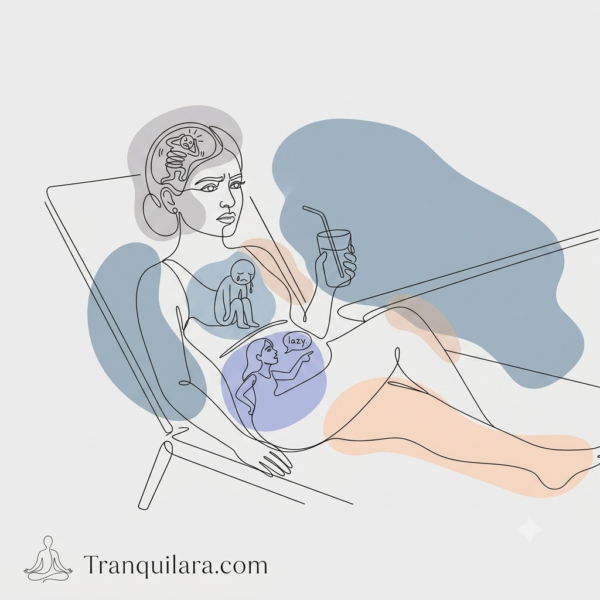
The greatest trick burnout plays on an educator’s mind is convincing you that you are simply “lazy” or failing at self-care.
When your autonomic nervous system drops out of active fight-or-flight and into a chronic freeze state, your energy reserves are entirely depleted. Your brain is actively trying to protect you by shutting down non-essential systems.
In this state, trying to execute a complex, multi-step self-care routine actually triggers more stress. Recovery isn’t about doing more; it is about strategically doing less in a way your nervous system actually understands.
Overcoming the “Savior Complex” and the Guilt of Stillness
Before we change what your body is doing, we have to change what your mind is permitting. As educators, our identities are often wrapped up in a chronic savior complex. I had to realize that my own deep urge to keep fixing every broken system, keep repeating myself to the point of exhaustion, and keep saving everyone else at my own expense was the exact fuel burning me alive.
When a teacher drops into a freeze state, their brain interprets raw, unstructured rest as “failure” or “laziness.” This cognitive dissonance spikes your cortisol levels while you are lying on the couch, leaving you feeling just as exhausted after a weekend off as you did on Friday afternoon.
To heal, you must consciously reframe non-productive stillness not as an act of indulgence or an administrative failure, but as a mandatory, non-negotiable biological intervention.
The “Thaw” Protocol for Your Recovery
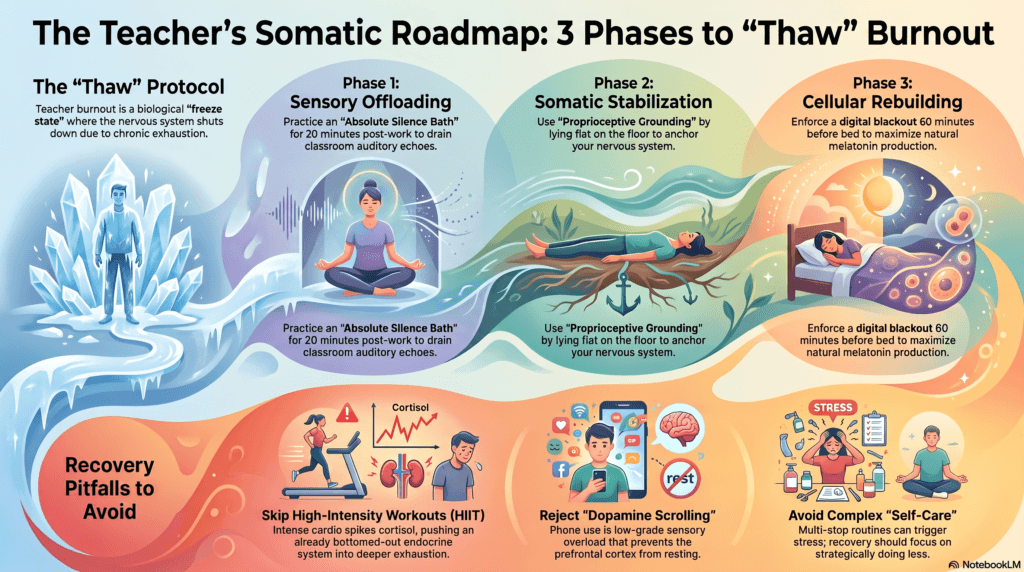
It can be a confusing process to jump from a deep, chronic burnout freeze back into a home parent summer lifestyle. You have to systematically “thaw” the nervous system. The key to this protocol is strict chronological sequencing—doing the right things in the wrong order will keep your body locked in a defensive pattern.
Phase 1: Nuclear Option Sensory Offloading
The primary goal is to turn off the sensory inputs actively triggering your nervous system. You cannot heal while the auditory and visual echo of a chaotic classroom is still ringing in your ears.
- The Strategies: The Absolute Silence Bath combined with strategic structural decompression. You must cut off all noise for 20 minutes immediately after your contract hours end.
- Physical Intervention: To force the muscles in your neck and shoulders to release their defensive armor, apply deep, continuous heat directly to the upper shoulders and neck using a wet cloth microwaved for 10 seconds.
- The Tools: Incorporating an HSA/FSA eligible deep-tissue heated neck and shoulder wrap into your evening routine is one of the fastest ways to trigger neuro-muscular release and melt away deep physical tension. If there is no silence to be had in your home, grab this HSA/FSA eligible Bluetooth Hearing Protection headphones.
Phase 2: Somatic Stabilization
Once the immediate sensory noise is quieted, you must reconnect your brain to your physical body without triggering a spike in anxiety. Focusing on your body sensations helps quiet the constant mental noise.
- The Strategy: Proprioceptive Grounding. This means physically lying flat on the floor on your back with your knees bent, allowing gravity to take 100% of the structural weight off your spine.
- Physical Intervention: To mechanically force your autonomic nervous system to down-shift its heart rate and blood pressure, layer heavy, evenly distributed pressure across your torso. This safe boundary signals directly to the vagus nerve that the body is protected.
- The Tools: This Cooling Weighted Blanket stimulates deep touch pressure receptors while still keeping you cool in the summer.
- For a full breakdown and deeper dive, check out our article on “What is Burnout? Signs, Symptoms and Why It’s More Than Just Feeling Tired.”
Phase 3: Deep Cellular Rebuilding
Now that the physical buzzing has stopped and your system feels stabilized, you can begin replenishing the deep neurological and hormonal reserves drained by months of systemic stress.
- The Strategy: Circadian Realignment. True tissue and hormonal repair only occur during deep slow-wave sleep and REM cycles.
- Physical Intervention: Enforce a strict digital blackout 60 minutes before bed. Make your bedroom as dark as possible. Lower your room temperature to exactly 65–68°F. These conditions mimic evolutionary sleep cues and maximize natural melatonin production.
- The Tools: If your bedroom is too bright, try these very affordable Blackout Curtains or this FSA/HSA eligible Cooling Eye Mask.
What to Avoid: The Pseudoscience Pitfalls of Burnout Recovery
When you are desperate for relief, it is easy to fall prey to expensive marketing gimmicks. To protect your energy and your wallet, keep these peer-reviewed boundaries in place:
- Avoid High-Intensity Workouts (HIIT): Intense cardio or heavy cross-training spikes your systemic cortisol. If your adrenal system is already bottomed out, HIIT pushes you deeper into exhaustion. Opt for low-intensity walking or restorative floor stretching.
- Avoid “Dopamine Scrolling”: Lying on the couch for three hours scrolling through short-form social media feeds is not rest. It is a low-grade, high-frequency sensory overload that forces your prefrontal cortex to process continuous data, keeping your brain waves running hot.
- Avoid Cleanses and Detoxes: Your body does not need an expensive green juice powder or a restrictive liquid cleanse to recover. Your HPA axis (hypothalamus-pituitary-adrenal system) needs structural rest, consistent hydration, and simple, whole-food, plant-based nutrition.
Frequent Questions and Answers
What does “Somatic” mean?
In the context of burnout recovery, a somatic approach means treating your stress as a physical, biological reality happening in your nervous system, rather than just a mental or emotional problem. When you are deeply burned out, you cannot simply “think” or “meditate” your way into feeling better. Your brain fog, irritability, and chronic exhaustion are physical defense mechanisms. Somatic healing uses physical interventions—like deep touch pressure, temperature shifts, and sensory offloading—to talk directly to your vagus nerve and signal to your brain that it is safe to finally drop out of a defensive freeze state.
What is Proprioceptive Grounding?
Proprioceptive Grounding is a zero-willpower somatic technique that uses deep physical pressure to instantly anchor an anxious or “frozen” nervous system. “Proprioception” is essentially your brain’s internal GPS—the subconscious network that senses exactly where your body is in space. When you are deeply burned out, your brain often detaches from this map as a defense mechanism, leaving you feeling “dissociated” or like a floating head just trying to get through the day.
To fix this, you use external pressure to force a physical connection. By lying flat on a hard floor or layering a heavy weighted blanket over your torso, you flood your internal joint and muscle receptors with massive structural data. This sends an immediate safety signal straight to your brain that says, “You are anchored and supported,” instantly clearing brain fog and dropping your nervous system out of survival mode without requiring a single ounce of mental energy.
Why does standard self-care (like a spa day or a bubble bath) fail to fix deep teacher burnout?
Standard self-care treats burnout like everyday stress, whereas deep teacher burnout is an acute autonomic nervous system crisis.
When you spend months running on a hyper-vigilant adrenaline loop, your system eventually crashes into a protective “freeze state.” A bubble bath or a massage only addresses surface-level muscle tension for an hour. It does nothing to repair a bottomed-out HPA axis (your body’s stress-control center) or fix the profound sensory overload caused by a noisy classroom. Furthermore, because your brain interprets open-ended rest as “non-productive laziness,” standard self-care often triggers hidden guilt, which actually keeps your cortisol levels running hot while you are trying to relax.
What exactly is a “Silence Bath” and how do I do it if I have a busy household?
Standard self-care treats burnout like everyday stress, whereas deep teacher burnout is an acute autonomic nervous system crisis. The Absolute Silence Bath is a strict 20-minute boundary of zero external sensory input, executed immediately after your contract hours end. It is not meditation; it is raw sensory offloading.
You do not listen to a podcast on the drive home, you do not check your phone, and you do not stream music. If your home is chaotic, you perform this in your parked car before you ever pull into your driveway. If there is no silence to be had in your home, grab this HSA/FSA eligible Bluetooth Hearing Protection headphones. You sit in absolute silence, close your eyes, and allow the auditory and visual “echo” of 30+ children and school bells to drain from your nervous system before you transition into your personal life.
Why are high-intensity workouts (like HIIT or heavy cardio) bad for burnout recovery?
Your body cannot tell the difference between a high-intensity interval workout and running for your life from a predator. Both trigger a massive spike in cortisol and adrenaline. If your nervous system is healthy and regulated, that physical stress spike is followed by a healthy recovery wave that builds resilience. But if you are already suffering from chronic burnout, your stress hormones are severely dysregulated. Forcing your body through a grueling workout doesn’t relieve stress; it pushes your already bottomed-out endocrine system over the edge, leading to deeper physical exhaustion, localized inflammation, and severe brain fog the next day. Stick to restorative floor stretching, somatic grounding, or slow walking until your energy baseline stabilizes.
I can’t afford to quit my teaching job right now—can this somatic roadmap still help me survive the school year?
Absolutely. This roadmap is designed precisely because you cannot always change your external environment immediately. You do not need to quit your job to start healing your biology. By implementing the microscopic physical boundaries outlined in the protocol—like the 20-minute sensory offload, utilizing deep touch pressure via an acupressure mat or weighted blanket, and enforcing a strict pre-bed digital blackout—you are changing how your body reacts to the classroom. You are building a protective physical buffer that prevents your nervous system from completely collapsing into a freeze state during the school day, giving you the clarity and energy you need to map out your long-term options cleanly.
Take Your First Step Toward Long-Term Recovery
You do not have to memorize this timeline or figure out how to white-knuckle your recovery alone. Healing your body and setting real boundaries around your career requires structured, bite-sized guidance that respects your limited energy.
Affiliate notice: Some of the links in this description are affiliate links – if used, I will get a small commission at no cost to you. It’s just one more way to help me retire in this century. I only recommend things I use myself, that have really helped me personally or fully believe in! Thank you!